







Can State-of-the-Art Legal Video Make a Difference
in the Outcome of Court Cases?
Look at it this way. There are some 250 million souls out there in the USA. Most (and we’re talking in the 90% plus range) have and watch television. And a good deal of those people may end up on a jury at least once in their lifetime, if not more.
Another thing to consider here is the influence of TV on our youth, also known as "future jurors". This is definitely the video age. I don’t think anybody can deny that.
Along comes a case with some pretty complex facts that are really pertinent to the matter at hand. A well-presented video of the case can be an awfully powerful argument in favor of the point being made. This is because the jury is already grooved into accepting information from the TV. A good video is to-the-point and has impact in a way that written or even live testimony just can’t compete with.
Now, if you doubt what I’m saying, allow me to cite an example.
 Recently I was called upon to edit a five-day series of depos of top-level
people in a large corporation. These people were masters of
obfuscation and had obviously been groomed that way by their counsel.
They looked good, were smooth, and had all the right answers. Or so
it seemed.
Recently I was called upon to edit a five-day series of depos of top-level
people in a large corporation. These people were masters of
obfuscation and had obviously been groomed that way by their counsel.
They looked good, were smooth, and had all the right answers. Or so
it seemed.
The transcripts were worked over by a couple of hard-working attorneys who believed in their case. They brought the transcripts and videotapes of the original depos to me.
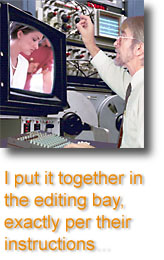
I put it together in the editing bay exactly per their instructions. No fancy Hollywood tricks; just straight clips from the depos, laid out in a predetermined sequence.
When that tape was played at the settlement conference, the big corporation folded and gave in to all demands.
What happened?
The attorneys, in reviewing the tapes of the depos, had found all the points where the witnesses had contradicted each other or, in some instances, even contradicted themselves on subsequent days of testimony. We put all these points back-to-back on a short, twenty-two minute videotape.
Nobody looks as stupid and willful as that soul who answers "yes" one day and "no" the next day to the same question.
Yes, this all could have been read to the jury or brought up in the settlement conference. But when the video of this was played, it was so dramatic that the opposition realized this was one tape they never wanted a jury to get close to.
My answer to the question, "Can state-of-the-art video make a difference to the outcome of cases?" is an unequivocal "Yes!" I’ve seen it happen quite often.
Lastly, if you find yourself saying, "Well I had a great case and put together a video, but it didn’t seem to work like this example...", then let me ask you a question. Is it possible that "state-of-the-art" was missing from the equation?
Certified Legal Video Specialist
Los Angeles, CA
|
Request Rates for Your Next Depo Schedule Deposition Video Online Now Chat Live With An Accurate Vision Representative
|